A Proper Salmon Coulibiac
There are few dishes more rewarding to master than a Salmon Coulibiac. This recipe will guide you through creating this magnificent pastry-wrapped parcel, step by step.
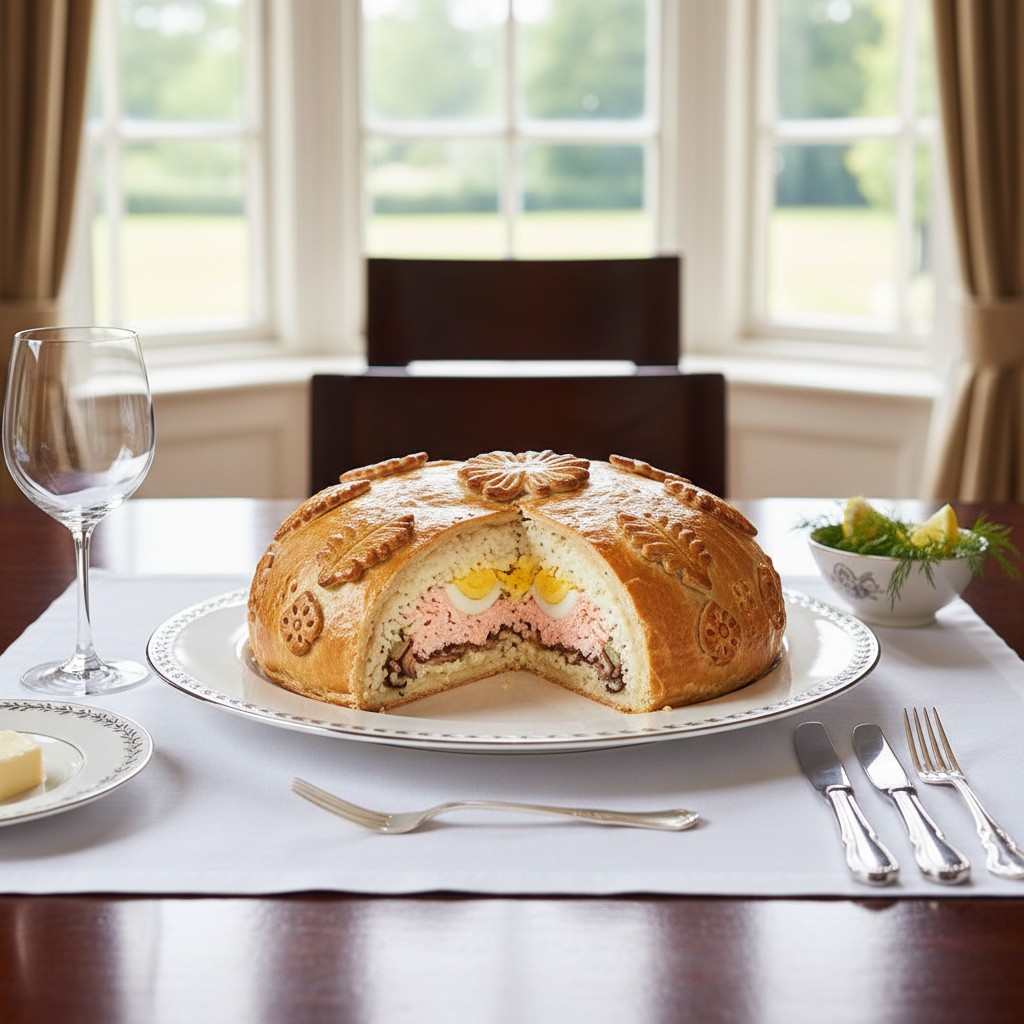
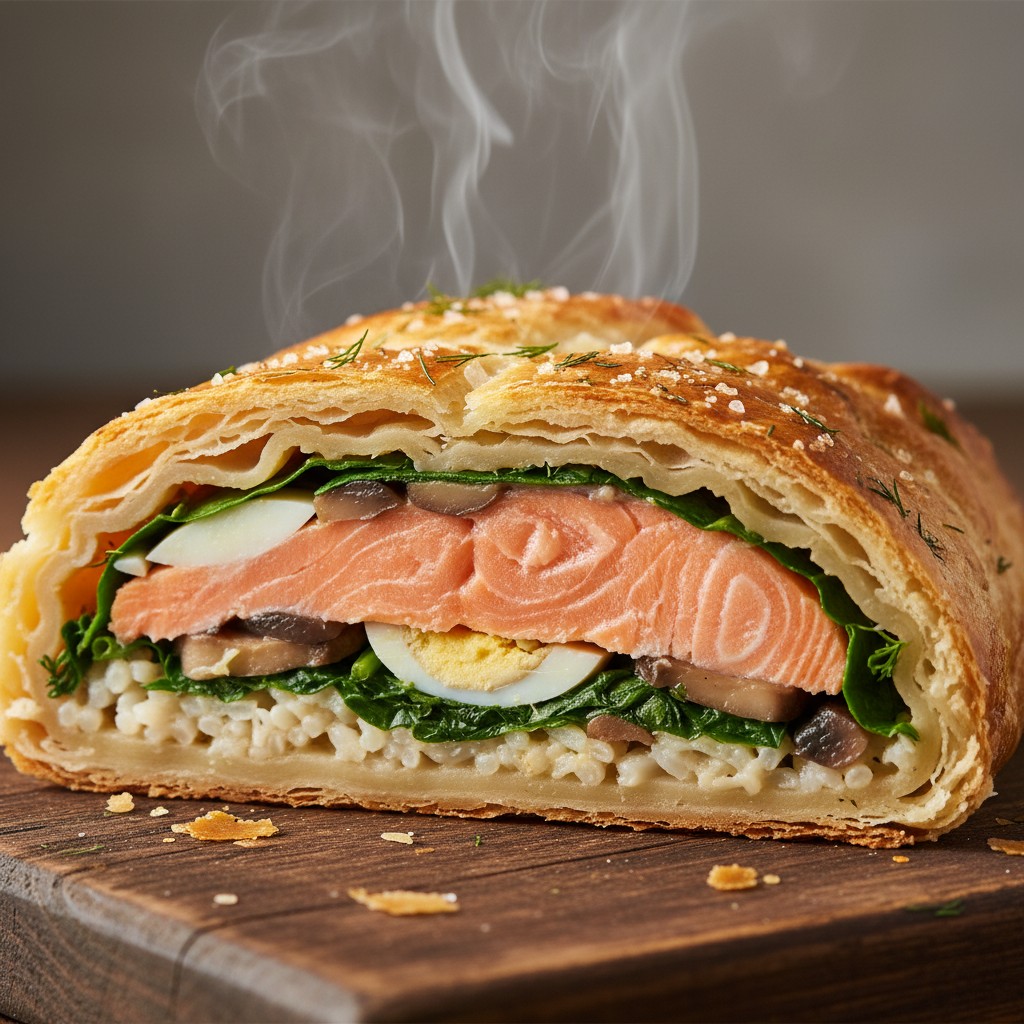
The Coulibiac is one of those dishes that seems to have fallen slightly out of fashion, which I think is a terrible shame. It is, quite simply, one of the most magnificent and rewarding centrepieces you can place on a dining table. Originally from Russia, it’s a complete meal encased in golden, buttery puff pastry – layers of succulent salmon, fluffy rice, savoury mushrooms, and hard-boiled eggs, all seasoned beautifully with dill and lemon.
Now, I know the list of components might seem a little daunting at first glance, but please don’t be put off. The secret to a successful Coulibiac is method and preparation. Each element is cooked separately and then assembled with care, rather like building something wonderful with edible bricks. By following the steps precisely, you can and will achieve a perfect result.
This is the sort of cooking that truly celebrates ingredients and technique. We build layers of flavour and texture that all come together in the final bake. It’s a project, certainly, but one that pays enormous dividends when you slice through that crisp pastry to reveal the beautiful mosaic of fillings inside. It is, in short, a triumph.
Why You'll Love This Recipe
- The thin crêpe layer acts as a crucial barrier, wrapping the filling to prevent any moisture from reaching the puff pastry, ensuring a crisp, non-soggy base.
- Making a mushroom 'duxelles' by cooking the mushrooms down until very dry concentrates their flavour intensely and removes excess water, which is vital for the pastry's integrity.
- Chilling the fully assembled parcel before baking is non-negotiable. This firms up the butter in the pastry, which then creates steam in the hot oven, resulting in a spectacular, flaky rise.
- Layering the ingredients in a specific order ensures a stable structure and a beautiful cross-section when sliced.
Ingredients
- 1 x 500g block of all-butter puff pastry
- 700g salmon fillet, skinless and pin-boned
- 1 tbsp olive oil
- 1 egg, beaten, for the egg wash
- Sea salt and freshly milled black pepper
- For the Rice:
- 100g long-grain white rice
- 2 tbsp chopped fresh dill
- Zest of 1 lemon
- For the Mushroom Duxelles:
- 250g chestnut mushrooms, finely chopped
- 2 shallots, very finely chopped
- 15g butter
- 1 tbsp dry sherry or white wine (optional)
- For the Crêpes:
- 50g plain flour
- 1 medium egg
- 150ml milk
- A little butter for frying
- Other Fillings:
- 3 large eggs, hard-boiled and roughly chopped
Equipment Needed
Large baking sheet · Baking parchment · Heavy-based frying pan (one large, one small) · Saucepans for rice and eggs · Rolling pin · Pastry brush · Sharp knife
Step-by-Step Instructions
- First, let's prepare all the components. Begin with the rice. Cook it according to the packet instructions until tender. Drain it very well, then return it to the warm pan off the heat. Fluff it with a fork and stir in the chopped dill, lemon zest, salt, and pepper. Spread it on a plate to cool completely.
- Next, the hard-boiled eggs. Place them in a small pan of cold water, bring to the boil, then simmer for exactly 8 minutes. Drain and cool them under cold running water before peeling and roughly chopping. Set aside.
- Now for the mushroom duxelles. Place the finely chopped mushrooms and shallots in a dry, medium-hot frying pan and cook for 5-7 minutes, tossing, until all their liquid has evaporated. Add the butter and continue to cook until the mushrooms are well-browned. If using, add the sherry or wine and let it bubble away. Season, then spread on a plate to cool completely.
- To make the crêpes, simply whisk the flour, egg, and milk together until you have a smooth, thin batter. In a small, lightly buttered frying pan, make 2-3 very thin crêpes, cooking for a minute on each side. These don't need to be perfect; they are our internal wrapping.
- Preheat your oven to 200°C (180°C Fan, Gas Mark 6). Season the salmon fillet on both sides. Heat the olive oil in a large frying pan and sear the salmon for just 1 minute on each side – we only want to colour the outside, not cook it through. Remove and let it cool.
- Time for assembly. Roll out the puff pastry on a floured surface to a large rectangle, about 35cm x 30cm. Place it on a baking sheet lined with baking parchment. Lay the cooled crêpes down the centre of the pastry, overlapping them to form a base for the filling that's roughly the same size as your salmon fillet.
- Spread half the cooled rice mixture over the crêpes. Top this with half the mushroom mixture. Carefully place the seared salmon fillet on top. Now, arrange the chopped hard-boiled eggs over the salmon, followed by the remaining mushrooms and finally the remaining rice. Press everything together gently into a neat mound.
- Brush the exposed pastry edges with the beaten egg. Now, bring one long side of the pastry up and over the filling, then bring the other side over to overlap it, creating a sealed parcel. Press down firmly. Trim the ends, tuck them under, and seal with more egg wash. You should have a neat, log-shaped parcel.
- Turn the whole parcel over so the seam is on the bottom. Brush the entire surface with more beaten egg. You can decorate the top with lattice work or leaves made from the pastry trimmings. Make 2-3 small slits in the top to allow steam to escape. Now, place the whole thing in the refrigerator to chill for at least 30 minutes. This step is vital.
- Finally, bake the chilled coulibiac for 35-40 minutes, or until the pastry is deeply golden, crisp, and puffed up. Let it rest for 10 minutes before slicing thickly to serve. This allows the filling to set and makes for neater slices.
Delia's Notes from the Kitchen
A Note on Assembly: The key to a handsome-looking Coulibiac is a neat and tidy assembly. Don't be afraid to use your hands to gently mould and press the filling into a compact shape before you wrap the pastry around it. A tightly packed filling not only looks better when sliced but is also more stable. Take your time with this stage; it's where the magic really happens.
How to Store & Reheat
The coulibiac is undoubtedly best eaten on the day it is made. However, leftovers can be stored, well-wrapped, in the refrigerator for up to 2 days. To reheat, place slices on a baking tray in a preheated oven at 180°C (160°C Fan) for 10-15 minutes until the pastry is crisp and the centre is hot. I strongly advise against using a microwave, as it will make the pastry terribly soft.
Frequently Asked Questions
Why did my pastry have a soggy bottom?
This is the classic challenge with any encased pie. There are three key defences: ensuring your mushroom and rice fillings are as dry and cool as possible, using the crêpe layer as a protective barrier, and thoroughly chilling the parcel before it goes into a hot oven.
Can I assemble the Coulibiac in advance?
Yes, you can. You can assemble it completely up to the point of baking (step 9). Wrap it very well in cling film and keep it in the refrigerator for up to 24 hours. You can then egg wash and bake it straight from the fridge, perhaps adding 5 minutes to the cooking time.
Do I really need to make the crêpes?
I would say yes, it's very important. They are the traditional and most effective way to absorb any juices from the filling and protect the pastry base. It's a small step that makes a very big difference to the final result.
Can I use a different kind of pastry?
While puff pastry is traditional for its light, flaky layers, you could use a good shortcrust pastry. The result will be different – more like a classic pie – but still delicious. The baking time may need to be adjusted slightly.
My pastry cracked open while baking. What went wrong?
This usually happens for one of two reasons. Either the seam wasn't sealed securely enough with egg wash, or you may have forgotten to make steam vents in the top. The vents are crucial to allow the pressure that builds up inside to escape gently.